The U.S. energy landscape stands at a pivotal crossroads. After two decades of flat electricity demand, a surge in demand driven by artificial intelligence and data centers is reshaping what the grid needs to deliver and how fast it needs to deliver it. A new analysis from KeyLogic’s OnLocation division analyzes what it might take for the U.S. to achieve the Trump Administration’s goal of up to 400 Gigawatts (GW) of nuclear power capacity operating by 2050.
The key finding: it is technically achievable but it will require an unprecedented level of sustained financial commitment, structural reform, and national will.|
~100 GW New SMRs by 2050 |
~200 GW Large AP1000 Reactors |
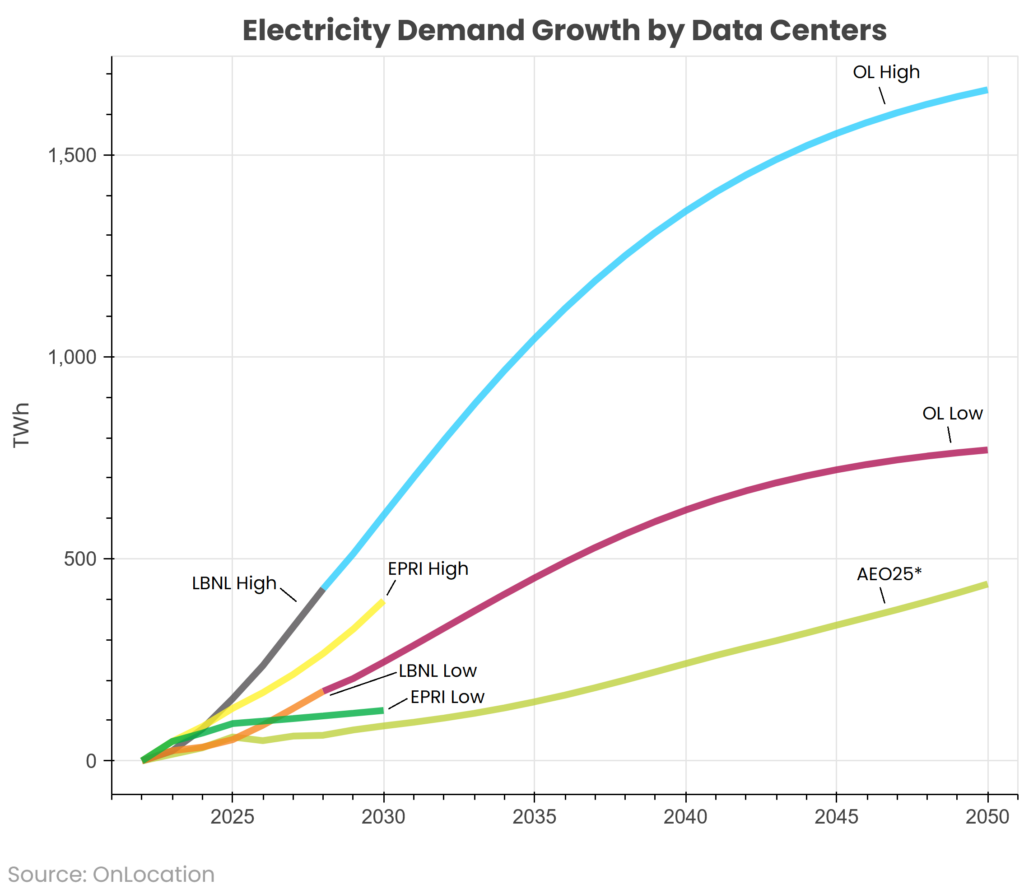
15x Data Center Demand Growth by 2050 |
The Demand Shock: AI Is Rewriting the Rules
For roughly twenty years, U.S. electricity consumption barely moved. Efficiency gains largely offset population growth and economic expansion. That era is ending. The explosive growth of AI model training and inference, cloud computing, and hyperscale data centers is creating a demand surge with no modern precedent.
According to a previous KeyLogic analysis, electricity consumed by data centers could grow 5 to 10 times above current levels by 2035 and more than 15 times by 2050 in high-growth scenarios. To put that in perspective, data centers could eventually consume almost 40% of today’s electricity demand.
This shift has already triggered a strategic recalculation across government and industry. The question is no longer whether demand will grow dramatically but rather who will supply that power and what technologies will meet the demand.
The Policy Signal: 300 GW by 2050
The Trump Administration has made nuclear power a centerpiece of its energy and national security strategy. Executive Orders signed in 2025 direct federal agencies to accelerate licensing, reinvigorate the industrial base, expand domestic uranium enrichment, and streamline reactor testing at the Department of Energy.
The stated targets are ambitious: facilitate uprates adding 5 GW of capacity at existing plants, begin construction of approximately 10 new large reactors by 2030, and add 300 GW of new nuclear power by 2050. If achieved alongside existing capacity, total U.S. nuclear generation would approach 400 GW; roughly quadrupling the current fleet.
|
Administration Target 300 GW New nuclear capacity added by 2050 — requiring construction to exceed any historical pace in U.S. history |
Industry Has Already Placed Its Bets
Before federal and state government engagement, the technology sector began making direct bets on nuclear. The KeyLogic report lists at least $20 billion in commitments from major digital companies seeking to secure firm, low-carbon baseload power for their data centers.
Microsoft signed a 20-year power purchase agreement with Constellation Energy to restart the former Three Mile Island site (now the Crane Clean Energy Center). Google struck deals to deploy roughly 500 MW of nuclear capacity by 2035. Amazon Web Services committed $500 million to X-Energy for advanced reactor development. Meta entered agreements with Vistra, TerraPower, and Oklo for both fuel and reactor capacity.
The Trump Administration has also announced a partnership with Brookfield Asset Management and Cameco to construct at least $80 billion in new large-scale reactors through Westinghouse Electric Company.
These commitments signal that nuclear power has become a commercial imperative and a key national & economic security priority going beyond just a policy aspiration.
The Modeling: Two Scenarios, One Hard Truth
KeyLogic’s analysis used a customized version of the U.S. Energy Information Administration’s National Energy Modeling System (NEMS) to evaluate two pathways forward.
The Reference Scenario incorporates updated policies including provisions of the One Big Beautiful Bill Act that rapidly phase out wind and solar tax credits, plus high data center demand growth. Under this path, the grid expands dramatically, but solar, wind, and natural gas do the heavy lifting. Nuclear accounts for only 12% of electricity generation by 2050.
The Nuclear Scenario layers in an additional financial incentive: a ‘Nuclear Power Premium’ applied as a supplemental investment tax credit to drive the model toward the Administration’s additional 300 GW target. The results show nuclear reaching 48% of total U.S. electricity generation by 2050, comparable to France’s nuclear share today.
Cumulative Nuclear Capacity Additions Under the Nuclear Scenario
|
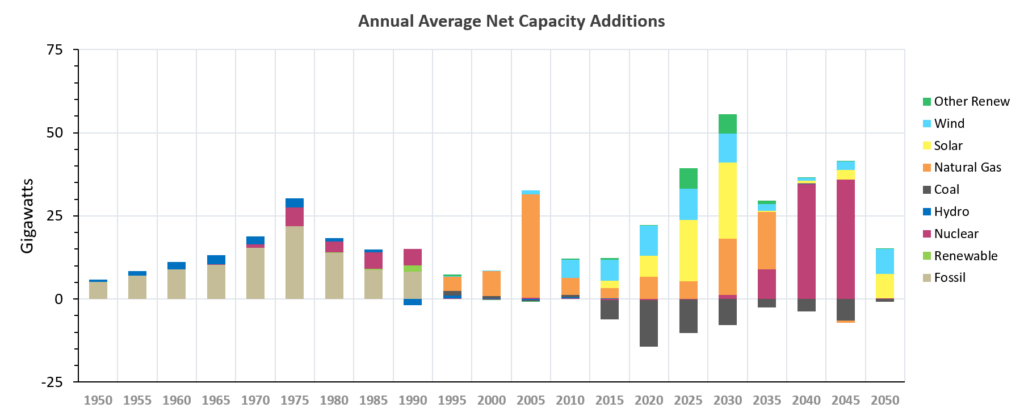
43 GW By 2035 |
202 GW By 2040 |
323 GW By 2050 |
Crucially, achieving this trajectory requires a pace of nuclear construction that exceeds any historical period in U.S. history, including the nuclear buildout of the 1970s. The analysis illustrates that the projected deployment rate is not merely ambitious, it is without precedent in the U.S.
Sustained Industry and Financial Commitment
The analysis also highlights the scale of additional financial support required to bridge the competitiveness gap between nuclear and its technology alternatives. Even with OBBBA tax credits in place, achieving 300 GW of new nuclear capacity would require a supplemental ‘Nuclear Power Premium’ averaging $99 billion per year between 2026 and 2050, expressed in real 2024 dollars.
If the industry achieves more aggressive technology learning, driven by serial construction, manufacturing scale-up, and improved project execution, that figure drops to $69 billion per year. This is not a subsidy in the traditional sense. The premium is a proxy for the total financial support required –from any combination of government grants, loan guarantees, long-term power purchase agreements, and private capital commitments– to make nuclear construction economically viable at the scale required.
What Needs to Go Right
The analysis is straightforward about the conditions that must be met for the nuclear scenario to materialize. These go well beyond financial incentives:
- Regulatory reform must succeed. The Executive Orders directing reform of the Nuclear Regulatory Commission are assumed to be successfully implemented — cutting years from licensing timelines and enabling faster permitting for new builds.
- The workforce must be rebuilt. Nuclear construction in the U.S. atrophied for decades. Restoring and expanding the skilled workforce needed for simultaneous multi-unit builds is a structural challenge that cannot be solved with money alone.
- Supply chains must be established. From specialized steel and reactor pressure vessels to enriched uranium fuel, domestic supply chains for large-scale nuclear construction do not currently exist at the required scale.
- Technology learning must accelerate. The model’s more favorable outcomes depend on serial construction — building enough reactors to drive down costs through manufacturing experience, as South Korea and China have done.
- Public and community acceptance must hold. The report identifies community acceptance of both data centers and nuclear plants as a priority research area requiring attention at the local and state level.
The report notes that in the Nuclear Scenario, nuclear capacity displaces a significant portion of what would otherwise be wind, solar, and natural gas investment. Total installed capacity is lower in the nuclear scenario because nuclear power’s higher capacity factor and higher availability mean fewer gigawatts are needed to deliver the same amount of energy as intermittent renewables while also meeting peak demand requirements.
The Bottom Line
This analysis does not conclude that 400 GW of U.S. nuclear capacity is impossible but that it is conditionally achievable, under identifiable assumptions.
The analysis makes clear that meeting the Administration’s targets is not primarily a technology problem. The large AP1000 reactor is a proven design. Small modular reactors are approaching commercial deployment. The challenge is industrial, financial, and institutional. Rebuilding the capacity to construct nuclear plants at scale — after a generation of dormancy — is a national undertaking comparable in scope to building the interstate highway system or the original nuclear fleet.
For policymakers, investors, and energy planners, the report offers a sober but constructive message: there is a pathway to achieving industry’s needs and the Administration’s goals, but it will take a historic and sustained level of technological, financial and policy commitment.
This analysis is a first step in evaluating the potential for nuclear power to meet the energy needs of AI & Data Centers in line with the Trump Administration’s goals. Further research is needed and there are many uncertainties to resolve, e.g., the growth of AI, data centers and other electric loads, central vs. on-site power generation, technology costs and performance, and future enabling policies & regulations.
KeyLogic, a subsidiary of System One, is an independent analysis firm that uses quantitative methods to better inform business decisions and policy development at a wide variety of energy sector organizations, including government agencies, non-profit organizations, and energy-related businesses that represent a broad spectrum of interests. Contact us for a free consultation at: Francisco de la Chesnaye / VP, OnLocation, fdelachesnaye@onlocationinc.com